
Menu
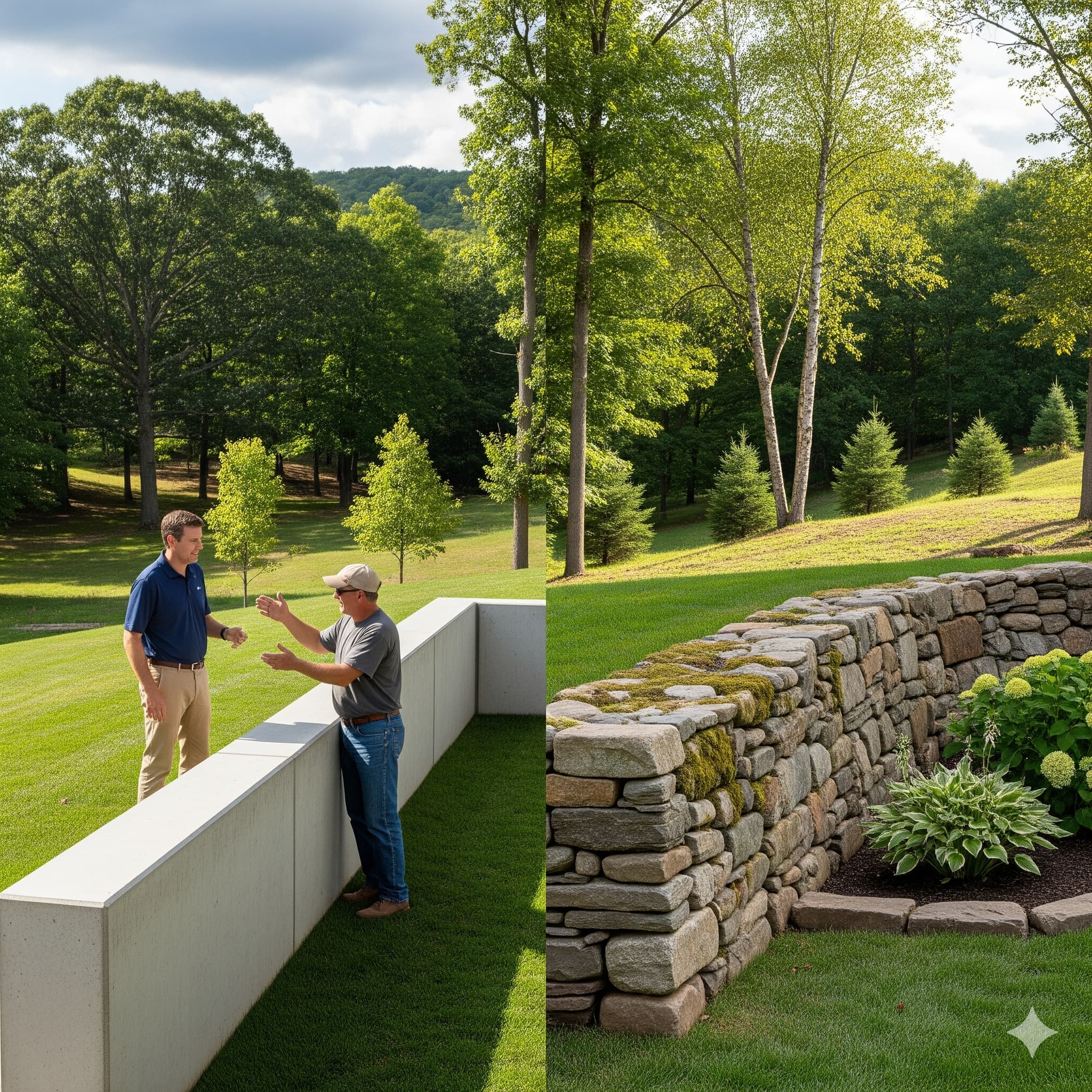
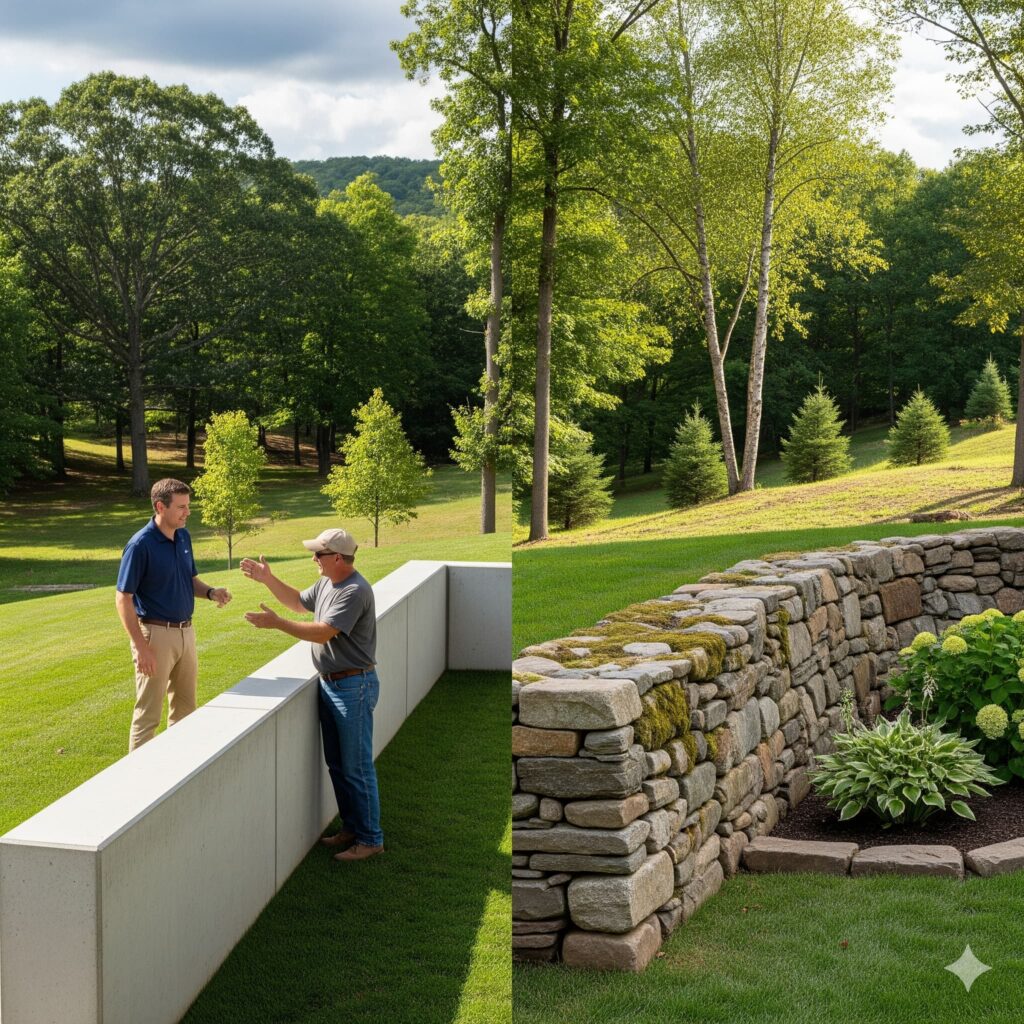
Concrete vs. Stone Retaining Walls: What Works Best in CT?
Concrete Retaining Wall New Haven
Connecticut property owners facing slope stabilization challenges must carefully evaluate retaining wall materials to ensure optimal performance in the state’s demanding climate conditions. While both concrete and natural stone offer viable solutions, concrete consistently demonstrates superior advantages in strength, versatility, cost-effectiveness, and long-term durability for Connecticut applications, particularly in areas like New Haven’s diverse neighborhoods from the Hill district to Cedar Hill.
Superior Structural Integrity of Concrete Walls
In terms of structural performance, concrete retaining walls far surpass natural stone walls. Engineered designs in concrete systems give a safety factor of 10 times greater than natural stone, allowing professional installations of concrete walls to handle walls of up to 20 feet high. In comparison, natural stone walls will begin to fail structurally as soon as they exceed 4 feet high and will require extensive engineering and planning to reach safe design loads. The ability to build higher retaining walls with concrete is especially important when you consider that Connecticut has many neighborhoods with large elevation differences, such as Newhallville and the Dwight neighborhood.
Load Calculations and Flexibility for Site-Specific Conditions
Engineered reinforced concrete retaining walls provide steel reinforcement to form a composite structure that cannot be achieved with individual pieces of natural stone. With this approach, engineers can calculate loads precisely and optimize structures for site-specific conditions. Also, concrete retaining walls are able to accommodate a wide range of soil pressure, groundwater levels, and seismic activity, while still maintaining their structural integrity for hundreds of years.
Uniform Properties of Concrete
As a building material, concrete is a uniform product that has consistent and predictable mechanical properties (strength) across an entire retaining wall structure, whereas natural stone products vary in their mechanical properties (load capacity and potential failure point). This ensures that concrete retaining walls perform reliably under extreme weather conditions that occur frequently in Connecticut.
Climate Resistance in Connecticut
The extreme freeze-thaw cycles, heavy rainfall, and temperature fluctuations found in Connecticut necessitate retaining wall materials that will expand and contract continuously without failing. Specialized concrete formulations designed for Connecticut’s climate conditions contain air entrainment and additives to prevent frost damage and extend the life of the retaining wall.
Resistance to Freeze-Thaw Cycles
Concrete retaining walls constructed with properly designed systems to control the air voids will not experience freeze-thaw damage because the voids in the concrete will expand with ice without causing cracks. Natural stone retaining walls experience damage from the freeze-thaw cycles because of water infiltration into the joints, which causes destructive freeze-thaw forces resulting in movement and structural failure of the wall. This climate benefit is very beneficial for properties in Connecticut that experience the variable elevation changes seen throughout New Haven.
Moisture Management Superiority
Retaining walls made of concrete can also include built-in drainage systems, waterproof membranes, and strategically placed joints to successfully manage both surface and groundwater. Water can enter the space between stones in natural stone walls via gravity-driven seepage through uneven spaces, and then become trapped to cause additional freeze-thaw damage to the wall.
Economical and Value Engineering
Concrete retaining wall systems provide excellent value by being more affordable in terms of raw materials used, faster to install, and requiring less maintenance over time than natural stone wall systems. The cost savings will increase for larger projects because the efficiency and scalability of concrete retaining walls result in significant dollar savings.
Comparison of Material and Labor Costs
Materials needed to construct concrete retaining walls are typically 40-60% less expensive than those needed to construct a similar-sized natural stone wall. Additionally, concrete retaining walls generally require fewer skilled labor hours to install than natural stone walls do, since concrete retaining walls can be installed using standardized techniques, whereas natural stone walls require masons who have specialized skills and training to correctly fit and align the stones.
Benefits of Longer Lifecycle Costs
Concrete retaining wall systems will last 50-100 years or longer and will require little to no maintenance over that time frame, whereas stone walls generally require rebuilding or repairing of one type or another, usually due to settlement, joint failure, or other forms of weather damage, within 20-40 years. Therefore, the extended service life of a concrete retaining wall, along with its lower maintenance costs, makes it the best long-term financial decision.
Versatility of Design and Aesthetics
Concrete retaining wall systems can provide endless design options for property owners using advanced techniques such as stamping, staining, texturing, and forming to mimic virtually any natural material appearance. As a result, property owners can choose a design that meets their desired aesthetic preferences while taking full advantage of the superior structural performance provided by concrete retaining walls.
Aesthetic Options Using Decorative Concrete Finishes
Using advanced concrete finishing techniques, a concrete retaining wall system can be made to appear identical to natural stone, brick, or timber, yet will provide superior durability and weather resistance. Decorative concrete finishes include, but are not limited to, integral coloring, acid staining, and textured surfaces that can match virtually any architectural design theme or landscape design theme.
Capabilities of Custom Formed Concrete Retaining Walls
Due to its moldable nature, concrete allows for the creation of complex curved walls, integrated planters, steps, and architectural features that cannot be created with natural stone wall systems. This increased design flexibility allows for creative solutions to challenging site conditions while continuing to maintain the structural integrity and cost-effectiveness of a concrete retaining wall.
Time and Disruption Savings Using Rapid Construction Methods
Concrete retaining walls are constructed much faster than natural stone walls, allowing for shorter project durations and less disruption to the surrounding property and residents. This is especially true for residential projects, where prolonged construction time can disrupt the normal daily routine and limit access to the property.
Fast Construction Techniques
Precast concrete retaining wall systems can be installed in days, rather than the weeks or months required for similar-sized natural stone walls. Furthermore, cast-in-place concrete retaining wall systems are constructed using only forming, placing reinforcing steel, and pouring concrete, whereas natural stone walls require labor-intensive placement and fitting of individual stones.
Independence of Weather Conditions
Concrete retaining wall systems can be installed in a variety of weather conditions with the proper protection, whereas natural stone wall systems require ideal weather conditions for proper curing of mortars and joint integrity. Therefore, concrete retaining walls can be constructed on a year-round basis and completed faster.
Less Maintenance Over Time Than Natural Stone Walls
Concrete retaining walls require very little maintenance over their lifespan as compared to natural stone walls that require constant repairs to their joints, replacement of damaged stones, and cleaning of their drainage systems. This lower maintenance requirement over time results in lower overall costs for property owners to own and maintain a concrete retaining wall system.
Resistance to Environmental Damage in Connecticut
Concrete retaining walls are resistant to damage caused by salt deicers used during winter months, acid rain, and biological growth that can erode the surfaces of natural stone walls. Additionally, the non-porous surface of a concrete retaining wall will prevent water from entering the wall and freezing, thereby maintaining the structural integrity of the wall for hundreds of years.
Ease of Repair for Concrete Retaining Walls
When repairs are needed to a concrete retaining wall system, repairs can be made using conventional concrete repair techniques and readily available materials, with the assurance that the repairs will be permanent. Repairs to natural stone walls are often more complicated and sometimes require special stone that matches the original material color and size, which can be difficult to find or expensive to purchase.
Sustainability and Environmental Considerations
Concrete retaining wall construction is environmentally friendly by utilizing local materials, reducing transportation needs, and enabling recycling of materials at the end of the service life of the retaining wall. Both factors contribute to Connecticut’s environmental protection policies while providing superior performance.
Availability of Local Materials
Concrete materials, including cement, aggregates, and reinforcement, are readily available from local suppliers located throughout Connecticut, thus eliminating transportation costs and environmental impacts. In contrast, natural stone materials are commonly sourced from remote quarries and transported to the project site, resulting in increased costs and environmental impacts.
Recyclability of Concrete Retaining Wall Systems
At the end of their service lives, concrete retaining walls can be recycled back into aggregate for use as base course for new roads, or used as aggregate for new concrete applications, whereas natural stone has limited recycling options and can be very expensive to dispose of.
Expertise of Professional Installers
To achieve successful retaining wall projects, experienced contractors are required who know the soils present at the project site, drainage requirements, and structural design principles that apply to the unique environmental conditions found in Connecticut. By hiring a professional installer who understands these factors, property owners can be assured of achieving the highest level of performance and longevity for their retaining wall systems. New Haven Concrete Company combines expert knowledge with proven techniques to deliver superior concrete retaining wall systems that consistently outperform natural stone walls in all relevant categories of performance.
LATEST POSTS