
Menu
Before You Pour: Concrete Driveway Drainage Tips in New Haven
Concrete Driveway New Haven
Proper drainage planning ensures your concrete driveway withstands New Haven’s challenging weather conditions and prevents costly water damage. Understanding Connecticut’s building requirements and local soil characteristics helps create durable installations that protect both your investment and the surrounding property.
Understanding New Haven’s Drainage Requirements
In order to meet Connecticut building code requirements, residential concrete driveways in New Haven have mandatory drainage standards. For example, all impervious surfaces within 10 feet of the exterior of building foundations must be sloped no less than 2% away from the structure, while the total grade must drop by a minimum of 6 inches within the first 10 feet from the exterior wall of the building foundation. Stormwater regulations also require that the owner prevent stormwater discharge from their private driveway onto public roadways in New Haven. In addition to these regulations, homeowners who live in coastal communities (such as Hamden bordering on the Long Island Sound) will likely encounter additional drainage design considerations that must be taken into account in designing and installing their residential concrete driveway.
Residential Concrete Driveway Building Code Compliance for Slope Requirements
Typical residential concrete driveway minimum thicknesses are 4 inches. However, because many concrete driveways are installed for proper drainage, there may be other factors that influence the final design and construction of the driveway. Driveway slopes cannot exceed 15% if paved; vertical grade changes must not exceed 12% in 10-foot sections. Driveways that run directly to state highways must be fully paved in the state’s right-of-way and shaped so as to accommodate the state’s drainage systems. This requirement is critical for homeowners whose driveways run into a state highway in an area such as West Haven or Branford.
Site Evaluation and Preparation for Residential Concrete Driveway Installations
Drainage requirements for residential concrete driveways vary depending on the type of soil in which they will be installed. The various types of soils present in New Haven will each require a different approach to ensure adequate drainage for the life of the driveway. Glacial till soils provide different drainage characteristics than brownstone sedimentary soils common to this area.
Soil Testing and Analysis in Connecticut
The Slate Laboratory of the Connecticut Agricultural Experiment Station in New Haven offers extensive soil testing and analysis. Their analysis includes texture evaluation, organic matter content, and drainage characteristics necessary to properly plan for concrete driveway installations in local conditions.
Soils with high sand content and loamy sands require more frequent drainage maintenance due to rapid water penetration, while fine sandy loams and clay soils require different drainage solutions. Identifying your own property’s soil type will enable you to determine what kind of base preparation will be required and what type of drainage solution will best serve your needs.
Strategic Design of Effective Drainage Systems
Concrete driveways rely on surface drainage and subsurface drainage to remove water from the site. Surface drainage directs water away from buildings and toward approved drainage collection points or storm sewer systems.
Techniques for Managing Surface Water
Use shallow crowns or cross-slopes to direct water toward drainage areas without creating slippery or difficult-to-traverse driving surfaces. A typical residential driveway has a 1-2 percent cross-slope and a 1-4 percent longitudinal grade to promote maximum water removal.
Decorative Drainage Solutions
There are several options available for decorative drainage solutions for your driveway, including permeable concrete borders and integrated channel drains. These products are beneficial for both functional and aesthetic purposes. They work very well in historic districts like East Haven or near Edgewood Park.
Management of Connecticut’s Freeze-Thaw Cycles
New Haven’s climate creates a unique set of challenges for residents of the city in terms of freeze-thaw cycles that can create damage toimproperly drainede systems installed under residential concrete driveways. When water becomes trapped beneath or within the concrete, it freezes and causes cracks and damage to the surface.
Climate-Specific Drainage Solutions
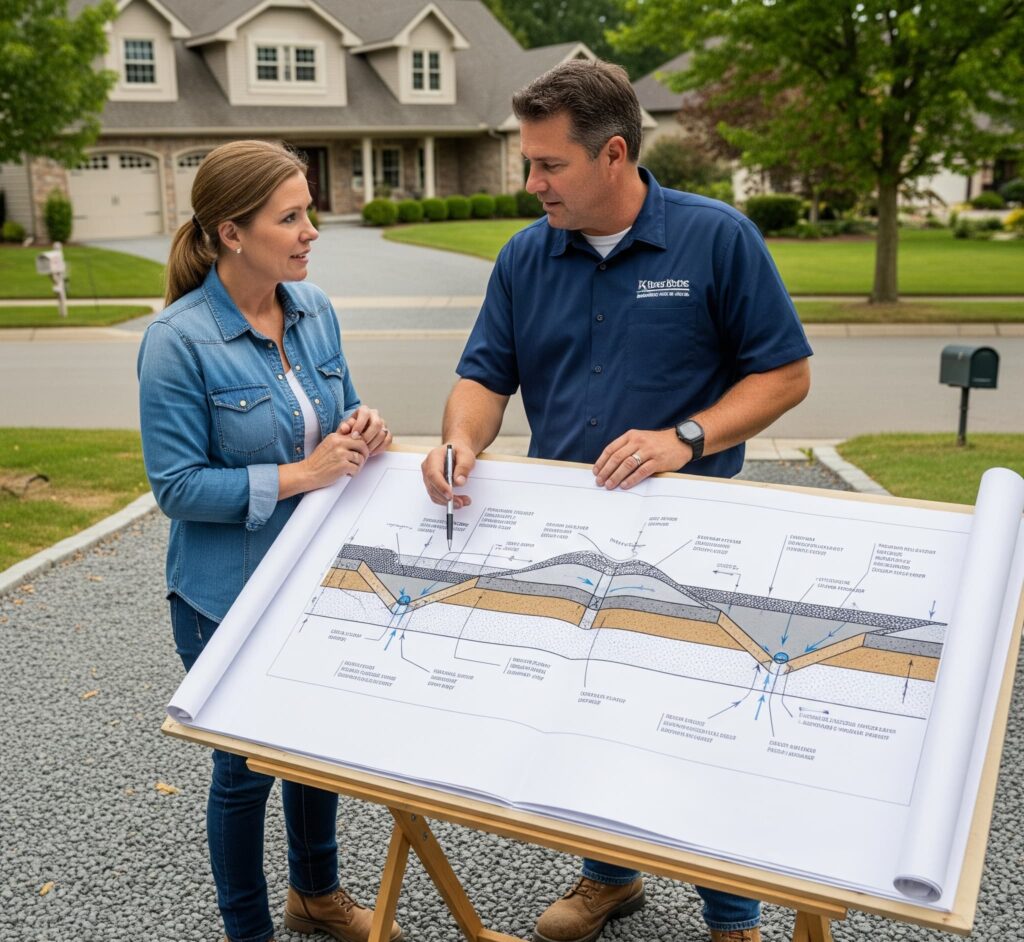
Subsurface drainage systems utilizing perforated pipes and gravel bedding beneath residential concrete driveways in areas of the state that tend to accumulate water are effective in reducing potential damage from freeze-thaw cycles. Subsurface drainage systems are beneficial for homeowners located in low-lying areas of the city or those experiencing seasonal fluctuations in their local water table.
Preparation of the Base for Your Residential Concrete Driveway
Base preparation consists of placing a 4-6 inch layer of compacted gravel beneath the concrete driveway. Gravel serves two functions in this regard; it acts as a structural base and provides drainage capability for water that accumulates in the driveway. Angular stone should be used instead of rounded gravel for better compaction and drainage in Connecticut’s unpredictable weather conditions.
Coordinating with Other Landscape Elements
When installing a new residential concrete driveway, drainage systems should be coordinated with existing landscape features and natural water flows. The installation of a new residential concrete driveway can negatively affect drainage on neighboring properties and possibly conflict with local watershed protection requirements.
Enhancement of Natural Drainage
Use the existing topography of your property to maximize drainage efficiency while minimizing the environmental impact of your residential concrete driveway. Homes located in neighborhoods such as Cedar Hill or Prospect Hill often have existing natural slope advantages that can be utilized in the design of your residential concrete driveway.
Vegetation Strips and Rain Gardens
Vegetation strips or rain gardens can be placed adjacent to your residential concrete driveway to capture and filter the stormwater flowing off the driveway. Vegetation strips and rain gardens not only assist in reducing erosion of your driveway and surrounding landscaping but also help to improve the overall aesthetic appeal of your property while complying with local environmental regulations.
Professional Installation
A professional concrete contractor is needed to properly design and install your residential concrete driveway. Contractors with experience in New Haven’s unique drainage challenges and regulatory requirements will perform the job correctly and prevent potential problems down the road.
Best Construction Practices
Install concrete driveways when the weather is favorable. Weather conditions are typically most favorable for concrete installation from the spring to fall months when the ground remains relatively stable. Do not pour concrete during periods of anticipated rainfall or when the ground is frosty and unable to provide a stable base.
Utility Coordination
Before beginning the process of excavating and installing a residential concrete driveway, contact the relevant utility companies to coordinate the location of any underground utilities that exist in the vicinity of your property. Utility coordination is especially important when installing residential concrete driveways in urbanized areas such as Dixwell or the Dwight Neighborhood in New Haven.
Maintenance of Residential Concrete Driveways
Regular inspections and maintenance of both the surface features and subsurface systems of your residential concrete driveway will maintain its effectiveness and extend the life of the driveway. Regular maintenance of your residential concrete driveway will also help protect the surrounding property from water damage.
Seasonal Maintenance Requirements
Prior to winter, inspect your residential concrete driveway and clear all leaves and debris from the drainage systems. If you notice any cracks in the surface of your residential concrete driveway that could potentially allow water to infiltrate and become trapped in the driveway, repair them before the onset of cold weather to minimize potential freeze-thaw damage to the driveway.
Protective Sealants
Apply protective sealants to the surface of your residential concrete driveway every 2-3 years to prevent water and chemicals from penetrating the concrete and damaging the driveway. Only use sealants specifically designed for use in Connecticut’s climate conditions and follow manufacturer recommendations for application procedures.
Cost-Effective Drainage Solutions
To balance the cost-effectiveness of your residential concrete driveway drainage systems with your project budget, consider a combination of short-term and long-term savings. Investing in quality drainage infrastructure during the initial construction phase of your residential concrete driveway will ultimately save you money in the long term by eliminating costly repairs.
Consideration of Long-Term Costs
When choosing the drainage solution for your residential concrete driveway, consider long-term maintenance costs, in addition to upfront costs. Oftentimes, investing in quality drainage systems initially will result in significant reductions in long-term maintenance costs.
With over 30 years of experience with local soil conditions and the extreme weather conditions associated with living in the New Haven area, our team of experts at New Haven Concrete Company can develop and implement drainage solutions for your residential concrete driveway that will protect your investment for years to come.
LATEST POSTS